|
Our futures are not written in the stars; our lives are certainly under our own control. Yet the processes of decision are often followed by revision as our plans get changed by circumstance and design.
We've all seen it in its simplest form: A fine family suffers a reversal, and is forced to a harder life, and the children who should have grown up pampered and protected are turned to a more difficult path. Although our destinies are not written, they are certainly formed by our own actions, by the actions of our parents and their parents before them.
There is a myth about Native Americans that holds they lived quiet pastoral lives with little upheaval until the coming of the Settlers. This might have been true of a few tribes, at least for a few hundred years, such as the Pueblo-dwellers who clung to their cliff houses for many generations, or the mound-builders of the Midwest, and perhaps it is true of some of the stronger Eastern tribes who had time to develop sophisticated governing bodies.
But for the most part, the tribes were in constant motion, surging and receding from their boundaries as they came in contact with each other. The nomadic tribes, in particular, were seldom long in one locale. This was doubly true after the coming of the horse, which unloosed a new kind of warfare, and new styles of hunting that promoted changes in old traditions.
Even before the arrival of the horse, warfare with stronger groups forced tribes to relocate. Sometimes they moved into more desirable lands, fertile and well stocked for hunters. But sometimes they were forced to seek refuge in desolation.
The Apache tribes were set upon a difficult path many years before they laid eyes on their first white man, even many generations before they met their first Spaniard. A strong people, they never collapsed, but they were forever changed, hammered by forces that molded them to fit into the most arduous life of any Native American tribe. Once formed by that life, they became the most feared of all the guerilla-style warriors in the American West.
Their earliest history is lost, too far back for even stories and legends to reveal. We know that they came down through Northwestern Canada from Alaska, because we can trace the roots of their language. The Apache and the Navaho both speak the Athabscan language. By this information, we know they were tied together as cousin-tribes, although they've been separated for longer than history can tell, with their own nations and their own customs.
Like most tribal names, "Apache" is actually a word given to them by a neighbor -- in this case, the Zuni. It means "enemy." The Apache called themselves "Inde" (Pronounced N-D) which means "The People." For a time, they were on the Plains, but stronger people pushed the Apache ever deeper into the mountains, and eventually into the deserts beyond. By 1750-1850 AD, the Apache occupied most of eastern Arizona and western New Mexico.
Things might have changed when the horses came, but in fact the Apache by that time had already mutated into desert and mountain folk. They never really cared that much for the Seven Dogs, so called because a horse could carry seven times as much and travel seven times as far as a work dog.
Don't mistake my meaning. Certainly they had horses, and avidly desired large herds. They caught and tamed wild horses, traded for them with other tribes and the Mexicans, and stole horses whenever they got a chance. But unlike the Commanches, the Apache tribes never really became horse cultures. They found the horse cumbersome for mountain fighting, and too visible across the wide-open spaces of the desert. They preferred to hunt on foot, so they could conceal themselves until close to their prey. The horses were great for long-range raids. But they were not revered by the Apache, and were sometimes even used for food.
This made the Apaches less strong than many of their neighbors, especially the fierce Commanches who were such great horsemen. So the Apache controlled little or none of the lush hunting grounds of the Plains, and were pushed further and further into the Rockies.
THE APACHE LIFE
What would the Apache people have been like, had they been able to stay in more fertile lands? We can only guess, but evidence is that they were deeply spiritual, kind to one another, with lives that were centered on love of family and home, and love of the Great Spirit. We get this opinion from what we know about them: they were strongly religious, strongly given to ceremony and prayer. They were romantic, and marriage was important to them. They celebrated marriage with a honeymoon during which the couple would go off for a week or two of uninterrupted togetherness.
We know they were interested in the gentle arts. They had a beautiful sense of design and decoration, still seen in their pottery, decorated clothing and other artifacts. And they were very musical. They not only had the ubiquitous drums and rattles, but they also had the flute and a nearly unique stringed instrument played with a bow, like a violin.
They learned the rudiments of agriculture while they were near the Pueblo people, and supplemented the hunters diet with tomatoes, peppers, squash, pumpkins and corn.
A man was not allowed to marry within his own band, and joined the band of his wife. There was division about whether it was acceptable to have multiple wives. Although women were expected to be monogamous and completely faithful, men might take a second or even third wife, usually choosing from among his first wife's sisters or other kin. From the woman's point of view, an extra wife was a laborsaving device, since she would share the work.
Men generally spent their time preparing their weapons, fighting, hunting or raiding, or sitting around with the rest of the guys telling stories, singing, dancing or praying. They also were extremely fond of gambling games.
They didn't give up these foundations of life when they were pushed into the hard lands, but they did acquire other characteristics born of need, and these helped build their strong fighting spirit.
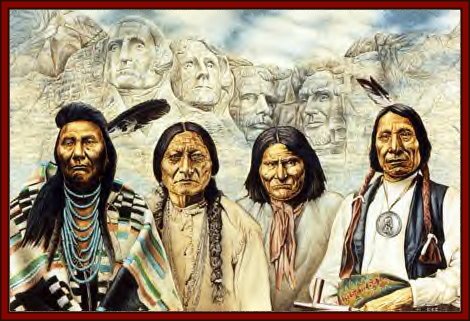
THE GREAT CHIEFS: COLORADAS, COCHISE AND GERONIMO
These were the forces that shaped the Apache destiny. Pushed into harsh lands, in many ways they became a harsh people. They were never overly friendly with any of their neighbors. They preferred the isolation of the wilderness, where they could keep the bands safely hidden. Apache warriors would leave these strongholds to fight, hunt or raid, but seldom permitted outside forces to enter. The new Apache lifestyle, with its predilection for combat, snapped sharply into focus after the Spaniards came in the 1500s. There was no possibility of coexistence. The conquerors were harsh and cruel, indiscriminately capturing and enslaving Native Americans, forcing them to work in Mexican silver mines. This was almost always a sentence of death: Native Americans didn't make good slaves, and the death rate in the mines was almost total. The continuing warfare with the Spanish slavers ensured there'd be no peace between the Apaches and the Mexicans.
By the late 1600s, raids into Mexican territory were a major part of the Apache economy. They went to acquire food, horses, cattle, useful objects (like cooking pots, metal weapons and firearms) and captives. By this time, the Apaches had worked up a serious hatred of all things Spanish, so the captured Mexicans faced a perilous future. They might be tortured and released, brutally killed, taken for use as slaves, or stolen to become family members through adoption or marriage. The Mexicans didn't consider any of these options attractive, so the hatred between the two groups continued to grow ever more violent. When white settlers came to the Southwest, they were met with the same terrors. At first, the Apache tried to stay well away from the Settlers, in their own camps and strongholds. They only mounted raids against the white men when the circumstances seemed to demand it -- dangerous encroachment on their homelands, or famine that made raids necessary to find food and livestock.
This pattern of desultory warfare with neighboring groups and raids for acquisition went on for a couple of hundred years. But the situation was deteriorating. By the early 1800s, Mexican troops were trying to fight back, and the Mexican government started offering bounties for Apache scalps (one poster offered 100 pesos for a warrior's scalp, 50 for a woman's scalp, and 25 for a child's.) Mangas Coloradas was probably born in 1791. He would have grown up during the continually accelerating war, and by the time he was fighting with his tribe, his main enemy had become the Mexican soldiers. Through bravery and success in battle he became chief of the Mimbreno Chiricahua band, and through continuing heroism and wisdom he became the primary leader of all the Apaches.
Mangas Coloradas was a large man, over 6'4", with great prowess in battle. But more than that, he was continually growing in leadership skills. He saw that skirmishes and raids were not the way to overcome the troops of Mexican soldiers; he witnessed how the Mexican commanders used their armies in battles, and he learned. For the first time in Apache history, he was able to unite all the bands under his leadership -- this alone is a testament to his intelligence, since these fiercely independent warriors were not inclined to take orders from anyone outside their own bands. But such was the magnetism of Mangas Coloradas that they would follow him.
Then, unlike any other Native American warrior, he was able to general his forces like the European-trained officers did, to plan concerted attacks. The times demanded this: when the Mexicans weren't dealing with their own internal strife, the large armies were sent north to harass their long-time enemies.
The event that most illuminates the brilliant generalmanship of Mangas was a victory over 3,000 well-equipped Mexican troops lead by a full cadre of trained officers. The Apaches were severely outnumbered and outgunned, and no doubt the Mexicans thought they'd have an easy day of it, but they were in for a big surprise. Like a Napoleon, with the precision of a Wellington at Waterloo, Mangas Coloradas divided his troops, flanked the marching Mexicans and routed them in what was probably the most stunning military victory ever enjoyed by the Native Americans.
But bigger trouble lay ahead. As miners spread through the West, the Americans increasingly became the larger threat. Every chance encounter between the two groups caused skirmishes. And there were constantly more and more white settlers.
Mangas Coloradas was a very smart man, and he knew that the Apache destiny could not lie in warfare against the Americans. So he tried to parlay with them, tried to come to terms. In 1860 he was invited to visit the Pinos Altos mining camp. But it was a trap; the miners grabbed hold of him, tied him to a tree, and then lashed him unmercifully with bullwhips.
Almost dead from his wounds, he made his way to the wickiup of his daughter and her husband…Cochise. Cochise was more than just a chief of the Chiricahua; he was probably the most universally admired Native American who ever lived. Strong, imposing in size, reportedly handsome and well spoken, he had always counseled his band to keep the peace, negotiate when possible, and only fight as a last resort. Well-known to the white settlers and militia, he was recognized as a man of honor who always spoke the truth.
He had made successful treaty allowing the whites to use Apache Pass. But he was enraged by the treatment of his father-in-law Mangas Coloradas, and closed the Pass. When Mangas regained his strength, he returned to Pinos Altos with a large band of warriors and drove the perfidious miners away. Then in 1862 when General James H. Carleton led his troops to try to regain Apache Pass, Mangas and Cochise fought together to hold the Pass against recapture.
There were battles and skirmishes all over the southwest territory, until the aging Mangas was wounded by a bullet in the chest. Weakened but alive, the Army took this opportunity to parley for peace, and invited him to Ft. McLane for a meeting. In January 1863, Mangas rode into the fort, but once again the white military betrayed their promise of a peaceful meeting. They captured and locked him up in the fort.
The commander told his men that he wanted Mangas dead, so the soldiers guarding him decided to have some fun with the old chief. They started heating their bayonets in the fire, then pressing the hot metal against his feet and legs to make him cry out. He would not scream, but finally he leapt to his feet. This was just what they wanted. They shot him dead, and reported that he was killed trying to escape.
Then the soldiers did something else. They cut off his head, boiled it, and sent the skull back east to be exhibited as a curio.
Apaches believed it was so Mangas couldn't find his way around the Happy Hunting Ground. Actually, it is unlikely that the perpetrators even thought of this. For several hundred years there's been a quasi-scientific interest in measuring the size of a skull, as an indication of the amount of brains inside. Mangas Coloradas had a huge skull, and was known for his great intelligence, and this is no doubt the reason for the atrocity on his body. It's been written that his skull compared favorably to that of Daniel Webster, the largest known brain up to that point. (Later, the same was done to Albert Einstein, who is said to have the largest brain ever studied.)
Mangas Coloradas' skull eventually was sent to the Smithsonian Institute, as were many other Native American bones. In November 1990, the Federal government passed The Native American Graves Protection and Repatriation Act, and the Apache tribe was offered back all known Apache remains. It seems likely that Mangas Coloradas skull was among that group, although they were insultingly labeled Tonto Apache #1, Tonto Apache #2, etc.
That ends the saga of the great Mangas Coloradas, the most brilliant tactician of all Native American chiefs. Betrayed, beaten, mutilated and disrespected, he still lives in memory as the greatest warrior-leader of all our people.
And so did his spirit live in Cochise, who was enraged when he heard the story of his death. This horrible injustice told him there could be no peace with the white men. He and his warriors continued their harassing of the white militia from the Cochise Stronghold in the Dragoon Mountains of Southern Arizona.
There were battles, skirmishes, raids and attacks. As the decade wore on, there were also more attempts to make peace. At one point, the Apache Pass was closed and traffic headed toward California was completely halted. Eventually the Pass was reopened, thanks to the famous Broken Arrow Truce. But every pause in the battle ended with betrayals and new assaults, and the Cochise War continued through the 1860s.
Yet it was futile, and Cochise knew it. It became apparent even to him and his followers that they were not going to win. Therefore, when General George Crook hit on the notion of sending Apache scouts into the Stronghold to negotiate, Cochise allowed himself to be convinced to take the offers of reservation land in their home territory, the Chiricahua Mountains. In the fall of 1872, they went in.
Cochise died there, of natural causes at age 62, on June 8, 1874. His band dressed him in war garments and war paint, and put on his head feathers. He was wrapped in a blanket and put on his horse, then taken to the Dragoon Mountains. They shot the horse, then used ropes to lower it and Cochise into a rocky chasm in a secret spot in the Dragoons. He rests there in peace, with honor, as he lived. And what of the reservation in the Chiricahuas? Do you even have to ask? Of course the promise was broken. It only took three years -- in 1875, the government decided to move all the Apaches to the San Carlos Reservation on the Gila River.
There was rebellion; many warriors refused to go. A new leader arose, Victorio, who lead 300 followers into flight September 1877. But he was recaptured in only a month. Victorio tried again a year later, with a band of 80 warriors. They roamed for almost two years, but in October 1880 Victorio was killed in Mexico. There were other attempts at rebellion, but gradually the Apaches at San Carlos Reservation decided to give up the fight.
All except one.
Goyathlay ("He who yawns") was with a small group of Apaches camped just north or the border in 1850. The men of the tribe attended a parlay in Mexico, at which they were given many gifts, including a great deal of liquor. The meeting went well, and the warriors returned to the camp. There the tribe celebrated, eating the food they'd been given, and enjoying the mescal. On the morning after the big feast, Mexican soldiers attacked and killed 130 Apaches, and captured 90 prisoners, mostly women and infants. Among the dead were Goyathlay's mother, wife, and three young children.
His grief was profound, and it changed him forever. Once known as a genial man, an affectionate husband and father, his personality completely altered. He became bitter, quick to anger, and given to bouts of extreme violence.
This tragedy and his resultant personality changes set Goyathlay on a lifelong path of revenge. Perhaps this is the reason Mangas Coloradas chose Goyathlay to carry the news of the massacre to other bands in a call-to-arms; it was Goyathlay who told Cochise and solicited the Chiricahua participation. Later, during an attack, a Mexican soldier cried out a prayer to Saint Jerome. That screamed cry was picked up, and became the war-name Goyathlay was known by for the rest of his life -- Geronimo! Eventually he remarried, a girl from the Chiricahua band, and thus became a member of Cochise' tribe. He rode with Cochise in many raids and battles against the Americans. However, Geronimo's chief enemies were the Mexicans, not the white settlers that occupied most of Cochise's time. Therefore, he often accompanied Mangas Coloradas on raids into Mexico.
Cochise finally accepted a truce proposed by the mail superintendent, Thomas Jeffords, in the well-known Broken Arrow treaty that allowed the mail drivers to pass through his lands unharmed. This led to a treaty in 1872 with General Oliver Howard, where Cochise accepted the Chiricahua lands as their reservation. Cochise insisted that Jeffords be named as the government's agent, and the two remained friends until Cochise died.
Jeffords continued on, even after Cochise was gone, but the situation began to worsen. Geronimo resumed his raids on Mexico, then in spring of 1876 killed two American stagecoach drivers, and followed that up by raiding a Settler's ranch. The public outcry demanded punishment to all Chiricahua Apaches. In June 1876, the government dissolved the Chiricahua Reservation and sent the band to San Carlos. Although the tribal leaders agreed to end the fighting, Geronimo refused to give up. About 70 warriors with their families left the reservation with him. But Mexican troops managed to separate the men, then captured most of the women and children and killed them all.
For several years, Geronimo murdered Mexicans and white settlers indiscriminately including their women and children. Periodically, he'd go back to the reservation, then recruit more followers to ride with him on his raids. At first he had about 100 followers; this number gradually diminished, as fewer and fewer Apaches agreed to go along with his attacks. By 1885, there were only 15 warriors, 12 women and 6 children in his band, hiding in Mexico. Finally, the last of his companions announced they were going in, and Geronimo surrendered in the fall of 1886.
But there was retribution; the Army would not let him rejoin his tribe at San Carlos. Instead, he and his warriors were sent to Ft. Marion, in St. Augustine, Florida. This was both for punishment, and as insurance that Geronimo would be unable to recruit more followers.
Geronimo spent eight years in Florida, begging to be allowed to return to his homeland, suffering from the unaccustomed humidity and poor conditions. Finally, in 1894, he was allowed to go to Fort Sill, Oklahoma, where the Kiowa and Comanche agreed to take him in.
Geronimo wrote his life story (dictating it to a journalist), which was filled with many self-justifications, exaggerations, and outright lies, although it did preserve a great deal of detail about Apache life and history.
He joined a church, but was later put out because of his gambling. Eventually he was allowed to join a Wild West show, and traveled to New York. He appeared at the St. Louis World's Fair, where he sold souvenir photographs, autographs, bows and arrows. In 1905, he was one of the Native Americans invited to ride in Theodore Roosevelt's Inaugural Parade.
Geronimo was never allowed to go back to his homeland; Arizona would not permit him in the state. He died in 1909 at age 80.
Strictly speaking, Geronimo shouldn't be included in this account of great chieftains. He really wasn't a chief, only the leader of some renegades. He went against the wishes of his own tribe by continuing a futile war. And he used terrible brutality even against women and children, shaming his own people with his savagery. The result of his actions was that the Apaches received more cruel treatment than might have otherwise been the case.
Yet the heart rises up to meet Geronimo, this last warrior who refused to surrender. His name is our battle cry when surrender is not an option; his is the spirit invoked when America's bravest soldiers leap into destruction. All Americans nod the head in memory of the man who would not give up, and his name lives on forever reflecting the honor of determination even unto death.
THE APACHES HAD THE MOST
A case can be made that the Apaches were once the most prayerful Native Americans in the land. They were among the most artistic, among the most musical of all the tribes. If things were different, they might have lived the most gentle and pastoral lives, hunting and farming and preserving their own traditions.
Being pushed into harsh lands made them change in order to survive, and they may have become the most harsh of the warrior bands. Because of the harsh lands where they lived, they didn't become a true horse culture so couldn't compete with other tribes. This meant they lost the lush plains hunting grounds.
Treated cruelly by Spanish slavers, their retribution against the Mexicans was long lasting and severe. When even the deepest, most hidden canyons could no longer protect them, they became the worst scourge of the encroaching Americans.
The Apaches had leadership of the most brilliant military strategist ever known by any tribe. They had the leadership of the most admired and honorable chief. And they also had the most savage and stubborn guerilla fighter known in the Americas. But what did this gain them?
A case can be made that the Apaches suffered most from the great changes that came to the West. By being the last tribe subdued, they seem to be the most hated by the sons of the Settlers. To this day, they are disrespected in their homeland and receive the most dishonor of any tribe, both in Arizona and in Mexico where mention of their name still brings fear.
Yet now their numbers are large. Where once only 5,000 waged war against change, now there are more than 30,000 Apache. Their pottery, art and silver works are considered the finest in the land, collected and displayed by admirers and museums. The tribe used their resources to buy herds, so they could become cattlemen. (Some people say they bought the cattle with gold taken long ago from the Spanish, and others say they found the gold in the Dragoon Mountains.) Many thousand Apache men have served in the American armed forces, bringing honor to themselves and their people. The Apaches are still fighting the war against poverty, drugs, alcoholism, and unemployment. But there's no doubt they're going to win.
|